How Fast Is Climate Change Changing? Earth’s Rotation Is Changing More Than at Any Time in 3.6 Million Years
Daniel Brouse¹ and Sidd Mukherjee²
June 2026
¹Independent Climate Researcher, Economist
²Physicist
How Fast Is Climate Change Changing?
Evidence for Nonlinear Acceleration Across Multiple Earth System Indicators
Earth Rotation Climate Change Rate Unseen in 3.6 Million Years; GPS Precision at Stake
Melting ice is lengthening days at an unmatched rate in millions of years
Climate-driven changes in Earth’s rotation may be contributing to navigational uncertainties that negatively affect battlefield outcomes and increase the risk of civilian casualties in contemporary conflicts.
Introduction
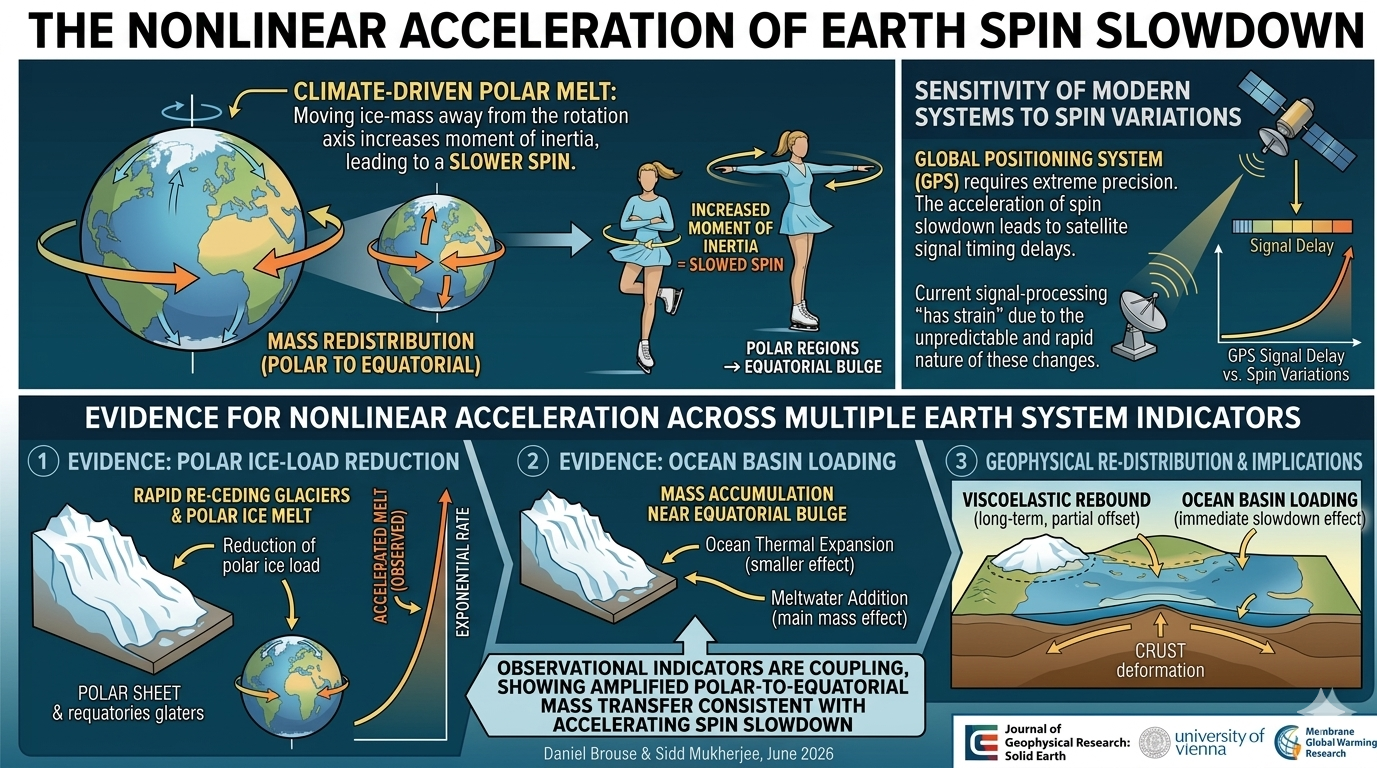
Melting ice at the poles is redistributing mass across the planet, with water moving from high latitudes into the oceans and, ultimately, toward the equator. One consequence of this redistribution is a measurable slowing of Earth's rotation. At the same time, multiple climate indicators suggest that the impacts of global warming are accelerating at rates far beyond those observed in the geological record. This is not simply rapid change—it may represent one of the most abrupt large-scale climate transitions in Earth's history.
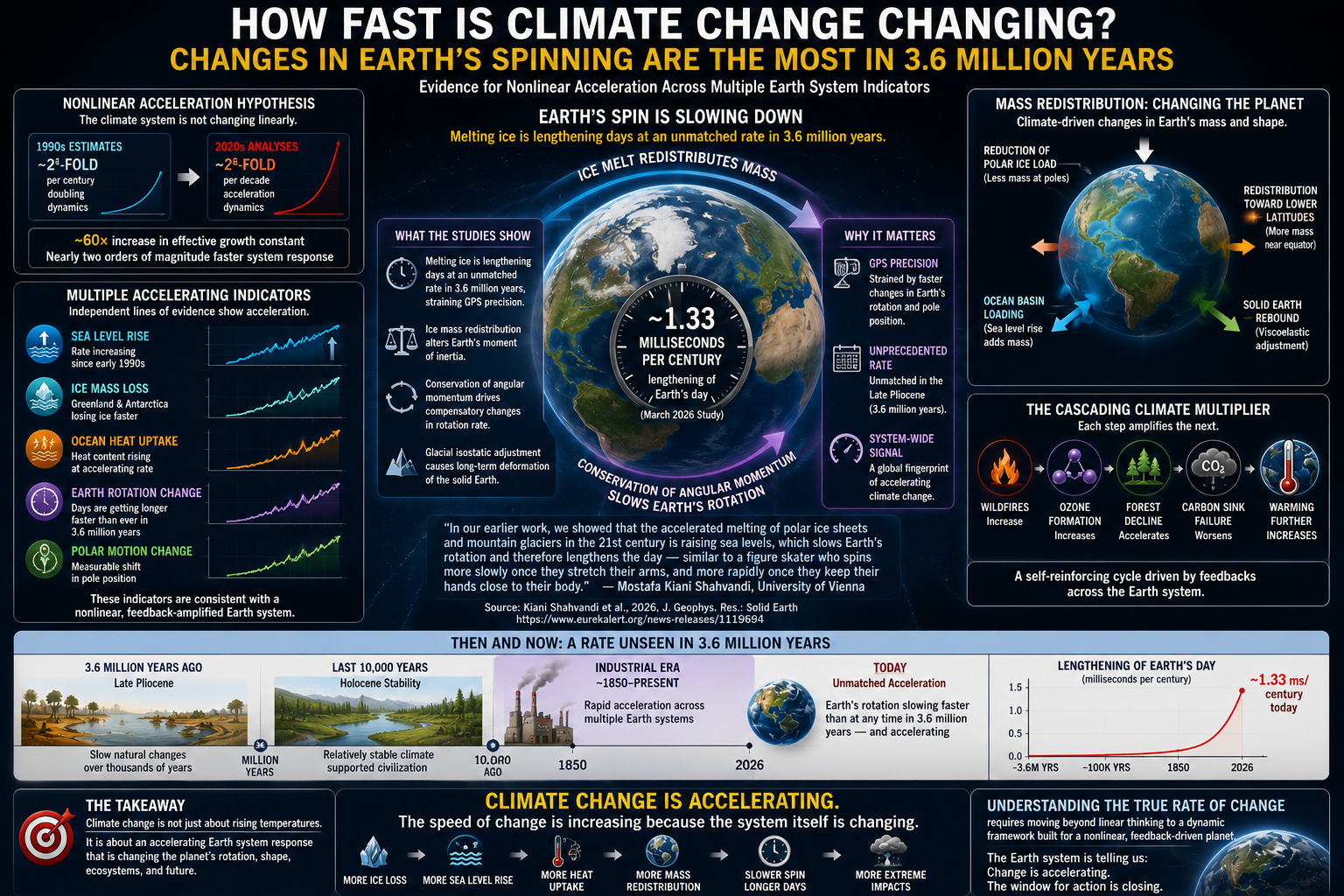
A change of roughly 1.33 milliseconds per century may appear insignificant. However, recent research indicates that the climate-driven acceleration in Earth's rotational slowdown is the greatest observed in approximately 3.6 million years. The importance of this observation lies not in the absolute magnitude of the change itself, but in what it reveals about the state of the Earth system. Small changes in Earth's rotation are consistent with large-scale mass redistribution driven by ice loss, rising sea levels, and shifting hydrological patterns—all consequences of a warming climate.
As Mostafa Kiani Shahvandi of the University of Vienna's Department of Meteorology and Geophysics explains: “In our earlier work, we showed that the accelerated melting of polar ice sheets and mountain glaciers in the 21st century is raising sea levels, which slows Earth’s rotation and therefore lengthens the day—similar to a figure skater who spins more slowly once they stretch their arms, and more rapidly once they keep their hands close to their body. What remained unclear was whether there were earlier periods when climate increased day length at a similarly rapid pace.”
When multiple independent indicators—including sea level rise, cryospheric loss, atmospheric circulation changes, ocean circulation shifts, and now rotational dynamics—show coherent acceleration, the significance lies in their coupling and consistency. Together, they provide evidence that the Earth system is responding as an interconnected whole rather than as a collection of isolated processes.
In this context, changes in Earth's rotation represent another line of evidence that the planet is dynamically adjusting through linked feedback mechanisms. As ice melts and water is transferred into the oceans, the planet's moment of inertia changes. This redistribution of mass influences ocean-atmosphere interactions, including the Atlantic Meridional Overturning Circulation (AMOC), jet stream behavior, temperature gradients, and large-scale pressure patterns. Freshwater inputs also alter ocean salinity and density, affecting heat storage, moisture transport, and energy redistribution throughout the climate system.
These processes help shape atmospheric rivers, Rossby wave amplification, climatic whiplash, and the persistence of extreme weather events. They contribute to the conditions that produce prolonged droughts, stalled flooding events, heat domes, severe storms, and rising sea levels.
The slowing of Earth's rotation is therefore not an isolated curiosity. It is a measurable consequence of the same physical processes driving many of the most consequential climate impacts observed today. While sea levels may rise only millimeters per year, the amount of mass being redistributed is enormous, and the resulting effects propagate throughout the interconnected ocean-atmosphere system. Viewed in this broader context, changes in Earth's spin provide yet another indicator that climate-driven transformations are occurring on a planetary scale.
Abstract
Climate change is increasingly characterized not only by rising mean temperatures and sea levels, but by accelerating rates of change across multiple coupled Earth systems. Within the framework of the Nonlinear Acceleration Hypothesis, observational data suggest that the Earth system is not responding linearly to radiative forcing, but instead exhibiting feedback-amplified dynamics consistent with accelerating response timescales.
Early formulations of this hypothesis in the 1990s estimated acceleration behavior on the order of ~2^1-fold per century doubling dynamics. More recent multi-indicator analyses suggest substantially shorter characteristic timescales, consistent with stronger feedback amplification on the order of ~2^6-fold on decadal scales, corresponding to an approximate ~60× increase in effective growth constant or approaching two orders of magnitude acceleration of the entire system.
This paper synthesizes multiple observational indicators—including sea level rise, cryospheric mass loss, and changes in Earth’s rotational dynamics—to evaluate whether climate change is accelerating in a nonlinear, feedback-driven manner.
1. Introduction: From Linear Change to Nonlinear Acceleration
Traditional climate frameworks often describe change as gradual and proportional to forcing. However, an increasing body of observational evidence suggests that key components of the Earth system exhibit nonlinear behavior, where feedbacks amplify initial warming into cascading system responses.
Under the Nonlinear Acceleration Hypothesis, climate change is not only increasing in magnitude but also in rate of change. This implies that the system’s “speed” is itself evolving, driven by reinforcing feedback loops involving ice loss, ocean heat uptake, sea level rise, and changes in planetary angular momentum distribution.
2. Evolution of Observed Acceleration Rates
When the Nonlinear Acceleration Hypothesis was first developed in the 1990s, observed acceleration behavior across climate indicators was consistent with approximately ~2^1-fold per century doubling-type dynamics.
More recent analyses incorporating multiple independent datasets suggest significantly shorter characteristic timescales, consistent with stronger feedback amplification:
- ~2^6-fold acceleration on a decadal basis
- ~60× increase in effective growth constant relative to early estimates
- Nearly two orders of magnitude increase in apparent system response speed
These values represent a convergence of multiple accelerating indicators rather than a single linear trend.
3. Sea Level Rise as a Primary Integrated Signal
Sea level rise (SLR) remains one of the most comprehensive integrative indicators of climate system change, reflecting:
- Ocean thermal expansion
- Ice sheet and glacier mass loss
- Gravitational redistribution
- Solid Earth deformation and isostatic adjustment
Because SLR integrates multiple processes, it serves as a leading composite metric for evaluating long-term climate acceleration.
4. Cryosphere–Rotation Coupling: Changes in Earth’s Spin
A second independent indicator of large-scale system change is the effect of ice melt on Earth’s rotation.
Recent analyses suggest that melting ice is measurably altering Earth’s angular momentum distribution, producing detectable changes in rotation rate and polar motion. One reported summary states:
“Melting ice is lengthening days at an unmatched rate in 3.6 million years, straining GPS precision.”
Additional geophysical research indicates that:
- Ice mass redistribution alters Earth’s moment of inertia
- Conservation of angular momentum drives compensatory rotational changes
- Glacial isostatic adjustment contributes to long-term deformation of the solid Earth system
A March 2026 study published in the Journal of Geophysical Research: Solid Earth quantifies this effect as:
- ~1.33 milliseconds per century lengthening of Earth’s day due to climate-driven ice melt
Source: https://www.eurekalert.org/news-releases/1119694
These results are described as unprecedented in the Late Pliocene geological record.
5. Earth System Geometry and Mass Redistribution
Beyond rotation, climate-driven mass redistribution is altering Earth’s physical structure:
- Reduction of polar ice load
- Redistribution of mass toward lower latitudes
- Ocean basin loading changes due to sea level rise
- Solid Earth viscoelastic rebound
These processes are coupled through gravity, rotation, and fluid dynamics, forming an integrated Earth system response rather than isolated regional effects.
Sea Level Rise: Then and Now
http://membrane.com/global_warming/Sea-Level-Rise-Historic.html
6. Synthesis: Evidence for System-Wide Acceleration
Across multiple independent indicators, a consistent pattern emerges:
- Sea level rise is accelerating
- Ice mass loss is accelerating
- Earth rotation changes are accelerating
- Geophysical redistribution processes are intensifying
A March 2026 study synthesis of geodetic and geophysical observations further supports the magnitude of these changes and their unprecedented rate in the modern geologic record:
https://www.eurekalert.org/news-releases/1119694
When viewed collectively, these indicators are consistent with a nonlinear Earth system response in which feedbacks amplify baseline warming into broader systemic change.
7. Conclusion
The available evidence suggests that climate change is increasingly characterized by accelerating rates of system response across multiple Earth domains. Within the framework of the Nonlinear Acceleration Hypothesis, these observations are consistent with a coupled system in which feedback loops govern not only the magnitude of change but the speed at which change unfolds.
Sea level rise, ice mass loss, and measurable changes in Earth’s rotational dynamics collectively suggest that the Earth system is entering a regime of enhanced sensitivity, where relatively small additional forcing may produce disproportionately large and rapidly emerging responses.
Understanding the true rate of climate change therefore requires moving beyond static trend analysis and toward a dynamic framework that accounts for feedback amplification, cross-system coupling, and nonlinear acceleration across the entire Earth system.
* Our probabilistic, ensemble-based climate model — which incorporates complex socio-economic and ecological feedback loops within a dynamic, nonlinear system — projects that global temperatures are becoming unsustainable this century. This far exceeds earlier estimates of a 4°C rise over the next thousand years, highlighting a dramatic acceleration in global warming. We are now entering a phase of compound, cascading collapse, where climate, ecological, and societal systems destabilize through interlinked, self-reinforcing feedback loops.
Tipping points and feedback loops drive the acceleration of climate change. When one tipping point is toppled and triggers others, the cascading collapse is known as the Domino Effect.